Skip to content


The tundra is one of the coldest places on Earth. Winters are long and dark, strong winds sweep across open land, and the soil stays frozen for most of the year. Even so, many animals live in tundras, from tiny insects to the polar bear.
If you are looking for examples of animals living in tundra regions, this guide has them. It covers where tundras are found, the animals of tundra habitat by region, the plants they depend on, and the clever ways they survive the cold.
Key Takeaways
- Arctic tundra: polar bears, caribou, musk oxen, arctic foxes, arctic hares, lemmings, snowy owls and rock ptarmigans.
- Alpine tundra: mountain goats, yaks, pikas, marmots and snow leopards.
- Antarctic tundra: mostly seabirds, penguins and seals, because very little land is free of ice.
- Survival tools: thick fur or blubber, camouflage, hibernation, migration and living in groups.
- Plants matter: lichens, willows, mosses and grasses feed the animals that live here.
What Is a Tundra?
A tundra is a cold, treeless biome with a short growing season. The word comes from the Finnish tunturi, meaning treeless plain. Winter temperatures can fall to about –76°F (–60°C), while the short summer can reach around 77°F (25°C) in some places. For more on climate, soil and location, see our tundra biome facts.
Even in summer, the deeper soil stays frozen. This frozen layer is called permafrost. It stops tree roots from growing deep, so the land is covered mainly with mosses, lichens, grasses, sedges and low shrubs.
Types of Tundra

- Arctic tundra: found around the Arctic Ocean, across northern Alaska, Canada, Greenland, Scandinavia and Siberia.
- Alpine tundra: found on high mountains above the tree line, such as the Himalayas, the Andes and the Rocky Mountains.
- Antarctic tundra: found on the Antarctic Peninsula and some sub-Antarctic islands.
Tundra vs Taiga vs Arctic
These three words are often mixed up.
- Tundra is a treeless biome with permafrost.
- Taiga (boreal forest) lies south of the Arctic tundra. It is also cold, but it has conifer trees such as spruce, fir and pine.
- The Arctic is a region around the North Pole. It includes ocean, sea ice and tundra.
Our guide to tundra vs taiga vs Arctic explains the differences in more detail.
Tundra Map: Where the Three Types Are Found
A map makes the three types easier to picture. Arctic tundra forms a ring around the top of the world. Alpine tundra appears as small patches on high mountain ranges on every continent except Antarctica, which has its own limited Antarctic tundra.
How Many Animals Live in a Tundra?
There is no single exact number, because counts depend on the area and on what is included. The tundra has fewer species than warmer biomes, but it is not empty. The Canadian Encyclopedia says the tundra supports more than 75 mammal species, about 240 bird species, 5 amphibians, 2 reptiles and roughly 3,300 kinds of Arctic insects. Some school and science sources give lower figures for the Arctic tundra alone, for example around 48 mammal species.
The best way to think about it is this: only a small number of animals live in tundras all year, and many more visit in summer.
List of Animals That Live in Tundras
Animals in the Tundra List: Quick Facts
| Animal | Type | Main food | Key adaptation | IUCN status* |
| Polar bear | Mammal | Seals | Thick blubber, dense fur, strong swimmer | Vulnerable |
| Arctic fox | Mammal | Rodents, birds, eggs, plants | Coat changes white and brown | Least Concern |
| Caribou (reindeer) | Mammal | Lichens, leaves, flowers | Wide hooves, long migration, cool legs | Vulnerable |
| Musk ox | Mammal | Grasses, mosses, lichens | Qiviut undercoat, herd defense | Least Concern |
| Arctic hare | Mammal | Arctic willow, twigs | Fast runner, white winter coat | Least Concern |
| Arctic wolf | Mammal | Muskoxen, arctic hares | Thick pale fur, pack hunting | Least Concern |
| Lemmings | Mammal | Leaves, shoots, roots, berries | Active under the snow | Mostly Least Concern |
| Snowy owl | Bird | Lemmings, small birds | Feathered legs, white camouflage | Vulnerable |
| Rock ptarmigan | Bird | Leaves, flowers, berries, insects | Seasonal camouflage, feathered feet | Least Concern |
| Arctic tern | Bird | Fish, invertebrates | Longest migration of any animal | Least Concern |
| Walrus | Marine mammal | Clams, seabed animals | Tusks, sensitive whiskers | Vulnerable |
| Narwhal | Marine mammal | Fish, shrimp, squid | Deep diving, long tusk | Near Threatened |
Resident vs Migratory Tundra Animals
Not every tundra animal lives there all year.
Animals that stay or mostly stay all year
- Musk ox, arctic fox, arctic hare, lemmings, rock ptarmigan, arctic wolf
- Snowy owl (it may move south when food is short)
- Arctic ground squirrel (it stays but hibernates)
Animals that migrate
- Caribou, which travel long distances between feeding areas
- Snow goose, tundra swan and northern pintail
- Arctic tern, Pacific golden plover and northern wheatear
- Sandpipers, loons and falcons
Summer is a race against time. Snow melts, shallow pools form, insects hatch, and birds arrive to feed and nest. If migratory birds fail to raise their young in this short window, they cannot start over.
Animals That Live in Arctic Tundras

This section covers the best-known animals. For a deeper look, read our guide to Arctic tundra animals.
Land Mammals
Polar bear: The polar bear (Ursus maritimus) lives along Arctic coasts and on sea ice. It is the largest living land carnivore, and its main food is seals. Thick blubber, dense fur and large paddle-like paws make it a strong swimmer and an effective hunter on the ice.
Arctic fox: The arctic fox (Vulpes lagopus) is a small, adaptable member of the dog family. Its coat is white in winter and brown or gray in summer, so it stays camouflaged all year. It eats rodents, birds, eggs and plants, and it often follows polar bears to eat leftovers.
Caribou (reindeer): Caribou are large herbivores with wide, crescent-shaped hooves. These hooves spread their weight on snow and help them dig for lichen. Some herds in Canada travel about 3,000 miles (5,000 km) in a year. They are also the only deer in which females grow antlers.
Musk ox: It has a long outer coat and a very warm, soft undercoat called qiviut. When wolves approach, the herd forms a tight circle to protect the calves.
Arctic hare: A fast hare that changes from brown or gray in summer to white in winter for camouflage.
Arctic wolf: A gray wolf subspecies with thick, pale fur that hunts muskoxen and Arctic hares.
Lemmings and voles: Small rodents that live under the snow and provide food for Arctic foxes, owls, and weasels.
Short-tailed weasel (stoat or ermine): A small hunter that turns white in winter and feeds mainly on rodents.
Arctic ground squirrel: It can hibernate for up to eight months in the coldest parts of its range.
Birds

- Snowy owl: a large white owl that hunts lemmings and has feathers all the way down its legs.
- Rock ptarmigan: a ground-dwelling bird that stays through winter. Its feathers turn white in winter and brown in summer, and its feet are feathered for warmth.
- Gyrfalcon: the largest falcon in the world.
- Snow goose, tundra swan and northern pintail: breed on the tundra and fly south for winter.
- Arctic tern: flies from the Arctic to the waters around Antarctica and back every year, about 70,000 km (over 44,000 miles).
- Arctic skua: a seabird that chases other birds to steal their catch.
- Pacific golden plover: young plovers are left behind in Alaska and make their own way to South America.
Marine Animals Along the Arctic Coast
Sea animals live in the cold waters beside the tundra and are part of the same wider ecosystem.

- Ringed seal and harp seal: thick blubber, and food for polar bears.
- Walrus: rests on sea ice and beaches, and uses its whiskers to find clams on the seabed.
- Beluga whale: a white, social whale with a wide range of calls.
- Narwhal: the male’s long tusk is actually an extended tooth.
- Bowhead whale: can break through Arctic ice and may live for over 200 years.
- Orca (killer whale): a top predator that hunts seals and other marine animals in polar waters.
- Blue whale: the largest animal on Earth, which feeds on krill in the rich waters of the polar regions in summer.
- Greenland shark: a slow shark that may live more than 400 years.
Alpine Tundra Animals
On high mountains, animals face thin air as well as cold. Mammals at high elevation often use oxygen more efficiently than animals at lower levels. See our full guide to alpine tundra animals for more species.
- Mountain goat: a sure-footed climber with hooves made for steep, icy ground.
- Alpine ibex: a wild goat of the European Alps that climbs steep, rocky slopes with ease.
- Yak: thick coat and strong lungs for high altitude.
- Pika: a small mammal that stores dried plants for winter.
- Marmot: hibernates in burrows through the cold months.
- Snow leopard: a quiet hunter of high mountain regions in Asia.
Antarctic Tundra Animals
Antarctic tundra animals are mostly seabirds and marine animals, because very little land is free of ice. Penguins such as the Adélie and gentoo breed along the coasts. The emperor penguin lives on the sea ice and coast around the continent, with thick feathers and a layer of blubber to survive extreme cold. Seals such as the Weddell, crabeater and leopard seal rest and hunt nearby, and the Weddell seal breeds on the ice. On land, life is limited mainly to tiny insects, mites and a few plants. Only two flowering plants grow there, along with mosses and lichens. Read more in our guide to Antarctic tundra animals.
Tundra Plants: 10 Examples
Tundra plants grow low and close together to escape wind and cold. Many flower early in the short summer so they can make seeds in time. Here are 10 examples of tundra plants:
- Arctic willow (Salix arctica): a low shrub with fuzzy catkins, and a main food of the arctic hare.
- Dwarf birch (Betula nana): grows only a few inches tall but spreads widely.
- Bearberry: a low evergreen shrub with red berries.
- Reindeer lichen (Cladonia rangiferina, also called caribou moss): a key winter food for caribou. It is a lichen, not a true moss.
- Cottongrass: not a true grass but a sedge, named for its fluffy white tufts.
- Labrador tea: a small evergreen shrub with leathery leaves.
- Tufted saxifrage: a small flowering plant that grows in dense cushions.
- Mountain avens (Dryas octopetala): a low flowering shrub common in Arctic and alpine areas.
- Pasqueflower: a flowering plant of sunny, gravelly slopes.
- Arctic poppy: a bright flower whose cup-shaped petals follow the sun.
Arctic moss and sphagnum moss are also common and help hold water in wet areas. Our full list of tundra plants with pictures covers more species and how they adapt.
Tundra Animals and Plants: How They Connect
Tundra animals and plants depend on each other.
- Lichens are winter food for caribou.
- Arctic willow is a major food for the arctic hare.
- Grasses and mosses feed muskoxen.
- Leaves, roots and berries feed lemmings and voles.
When lemming numbers rise, they eat many plants. Their droppings then add nutrients to the soil, which helps plants grow again.
Animal Life in the Tundra Ecosystem: The Food Web
- Producers: mosses, lichens, grasses, arctic willow and berries.
- Plant-eaters (herbivores): lemmings, voles, hares, caribou and muskoxen.
- Meat-eaters (carnivores): arctic foxes, wolves, snowy owls, gyrfalcons and polar bears.
- Scavengers: foxes and gulls feed on leftovers.
The chain is short, so a change in one part affects the rest. If lemming numbers fall, snowy owls and foxes have less to eat.
For more examples, see our guide to the tundra food web and food chain.
Tundra Animals Adaptations: How They Survive the Cold
Body adaptations
- Thick fur or feathers, plus fat or blubber, for insulation
- Musk oxen have a soft qiviut undercoat under their long outer hair
- Wide hooves and paddle-like paws help caribou and polar bears move over snow and ice
- Short legs, ears and tails reduce heat loss
- Caribou keep their legs cooler than their bodies, and their cold noses help save water when they breathe out
Behavior adaptations
- Hibernation: grizzly bears and ground squirrels rest through winter and live on stored fat.
- Migration: many birds and caribou travel to find food.
- Group defense: muskoxen stand together to protect their young, and arctic hares gather in groups.
- Life under the snow: lemmings use tunnels beneath the snow for warmth and safety.
Camouflage
- Arctic foxes, arctic hares, weasels and ptarmigans turn white in winter and brown or gray in summer.
Insects and natural antifreeze
Mosquitoes, blackflies, moths and arctic bumble bees appear in summer. Some insects make an antifreeze protein that stops ice crystals from forming in their bodies. The woolly bear caterpillar can freeze solid, thaw out and keep growing. Some insects take 10 to 15 years to grow up because summers are so short.
Read more in our detailed guide to tundra animals adaptations.
Endangered and Vulnerable Tundra Animals
Several tundra animals are listed as Vulnerable by the IUCN, including the polar bear, caribou (reindeer), snowy owl and walrus. The narwhal, beluga whale, ivory gull and Greenland shark are listed as Near Threatened. Many other tundra species are currently of Least Concern, but the list can change as conditions change, so check the IUCN Red List for the latest status.
The main pressures come from a warming climate, including loss of sea ice, thawing permafrost and changes in when food is available. Our page on endangered animals in the tundra goes deeper into each species.
Tundra Animals Pictures
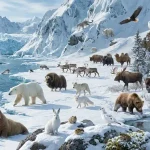
Pictures make it much easier to learn the animals. Below is a simple visual guide, with tundra pictures with animals and plants side by side.

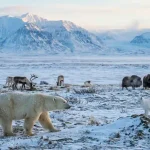
- Polar bear walking on Arctic sea ice
- Arctic fox in winter and summer coat
- Caribou herd eating reindeer lichen
- Muskoxen standing in a defensive circle
- Snowy owl perched on tundra with cottongrass
- Arctic willow and arctic hare
- Mountain goat on a steep alpine slope
- Adélie penguins on the Antarctic coast
Use your own photos or properly licensed images, and give each one clear alt text.
Tundra Animals for Kids
Here are some fun facts that make the tundra easy to remember.
- The arctic fox wears a white coat in winter and a brown coat in summer.
- Caribou are the only deer where both males and females grow antlers.
- Arctic terns see two summers every year because they fly from the Arctic to Antarctica and back.
- Lemmings do not jump off cliffs. That is a myth.
- A woolly bear caterpillar can freeze solid and still wake up in spring.
Quick Quiz
- Which tundra bird makes the longest migration of any animal?
- What do we call the frozen layer of soil under the tundra?
- What do caribou eat in winter?
- Is reindeer lichen a true moss?
- Which tundra mammal turns white in winter and follows polar bears for leftovers?
Answers: 1. Arctic tern. 2. Permafrost. 3. Lichens. 4. No, it is a lichen. 5. The arctic fox.
For more activities and simple facts, visit our page on tundra animals for kids.
Climate Change and Tundra Animals
The Arctic is warming faster than many other parts of the world, and this affects tundra animals in several ways.
- Sea ice loss: polar bears hunt seals from sea ice, so less ice means less hunting time.
- Thawing permafrost: it changes the land and releases stored carbon into the air.
- Changing plants: taller shrubs are spreading into some areas, which changes food and shelter for animals.
- Timing problems: if snow melts earlier or later than usual, migratory birds and caribou may arrive when food is less available.
Read more in our article on climate change and the tundra.
People and Tundra Animals
Sámi communities in northern Scandinavia and Nenets communities in Russia are known for herding reindeer. Indigenous peoples in the Arctic have long depended on animals such as caribou and seals for food and materials. Protecting these animals also protects their way of life.
Frequently Asked Questions
Arctic willow, dwarf birch, bearberry, reindeer lichen, cottongrass, Labrador tea, tufted saxifrage, mountain avens, pasqueflower and arctic poppy.
There is no single number. Canada’s tundra alone supports more than 75 mammal species and about 240 bird species, but many of the birds and some mammals only visit in summer.
“Tundra Town” is not a scientific term for a habitat, so the answer depends on what the name refers to. If you mean a tundra-themed place or activity, you can expect the well-known tundra animals in this guide, such as the polar bear, arctic fox, caribou, musk ox and snowy owl.
Animals from hot or tropical areas, such as camels, lions, elephants and giraffes, are not found in the tundra. Penguins are also not found in the Arctic tundra, because they live in the Southern Hemisphere.
Not in the Arctic. Penguins live in and around Antarctica, where tundra areas are very limited.
The arctic tern. It flies from the Arctic to the Antarctic and back every year.
No. The Arctic is a region around the North Pole. Tundra is one type of land habitat found within it.
Conclusion
The animals that live in tundras show how life can adapt to extreme conditions. From the polar bear and arctic fox to the caribou, snowy owl and tiny insects, each species has its own way to find food and stay warm, and each depends on the plants around it. As the climate changes, protecting permafrost, sea ice and tundra plants becomes more important for every animal in this ecosystem.

I am experts in Animal Behavior, Wildlife, Habitats and Species Facts. Clear, research-based and easy-to-understand animal content here.